

Big Barbwire Near You
Our Retail Partners
Duffer’s Premium Big Barbwire has retail partners in Missouri, Oklahoma, Texas, Alabama, and South Dakota.
Duffer’s Premium Big Barbwire is located in Missouri. We are excited to add retail partners that sell our high quality wire. Our retails partners are located in TX, MO, AL, SD, OK, and other great states (list below). Our customers include ranchers, farmers, and businesses. Our retail partners sell our wire in their stores and some offer same day pickup, delivery, and shipping. Our retail partners sell to individuals, families, businesses, ranchers, and farmers. If you don’t have a store near you, please reach out for a quote for delivery or shipping. Duffer’s Big Barbwire is made using high quality steel by specialized machinery, is made in the USA, and is versatile and customizable. If you would like to sell our big barbwire in your store, visit our sell locally page.

2nd Generation Big Barbwire - Length in between barbs

2nd Generation Big Barbwire - Barb Measurement
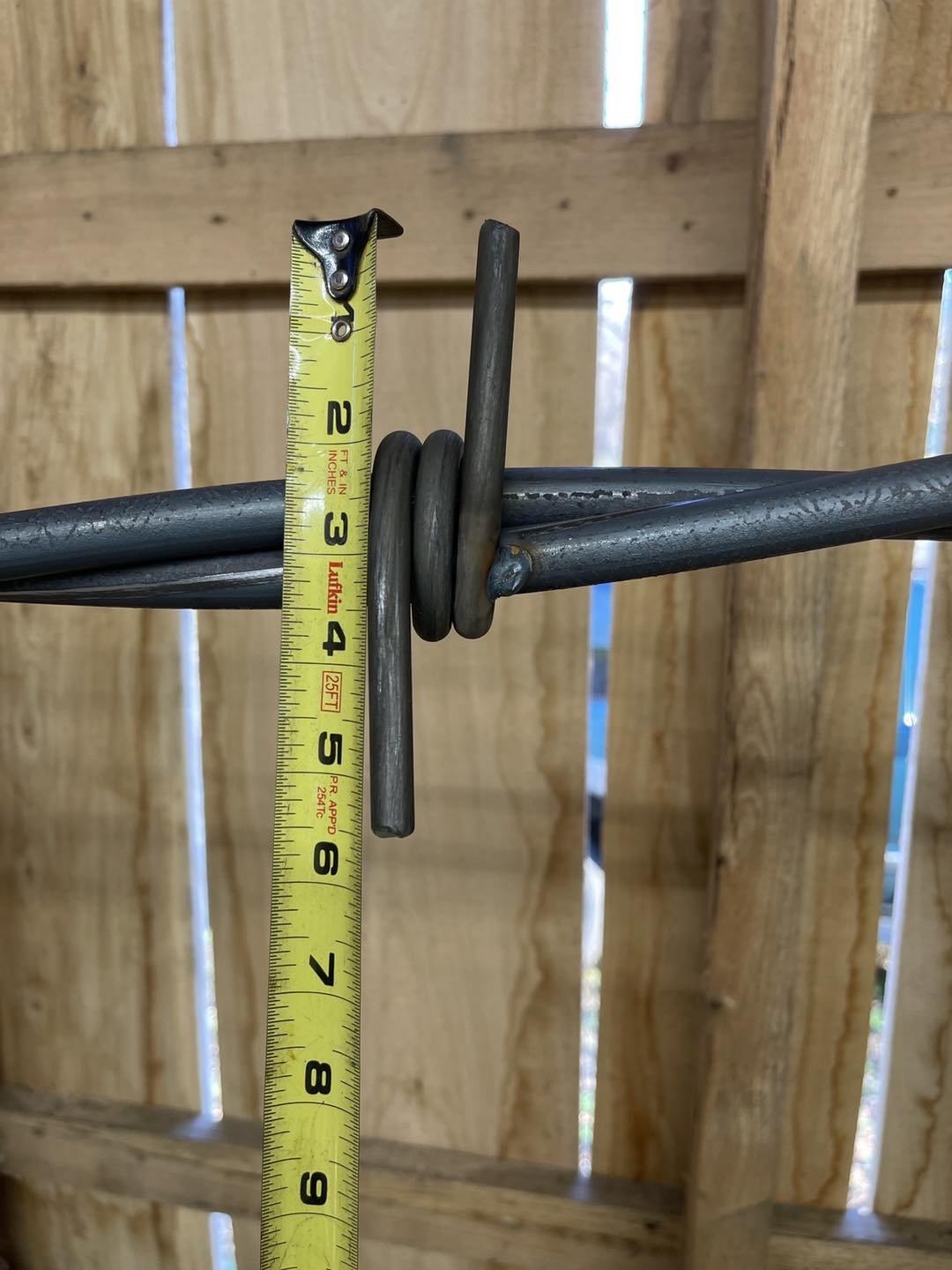
First Gen Big Barbwire - Barb Measurement

First Gen Big Barbwire - length between barbs
Barbwire Specifications
-
We specialize in premium, big barbwire. We offer 1st and 2nd gen wire. Retailers may carry both generations of wire or may only offer one type. Please talk to your store to find out more.
-
Our 1st gen big barbwire comes in lengths of 10 feet and is double 5/8” solid steel twisted together with a solid steel 3/8” barb every 11 inches and barbs are 5.5 inches across. Barbs are affixed and not adjustable - the barbs are on the outer edge of the wire.
-
Our 2nd gen big barbwire comes in lengths of 10 feet and is double 5/8” solid steel twisted together with a solid steel 3/8” barb every 12 inches and barbs are 5.5 inches across. Barb direction is adjustable - the barbs are on the inner edge of the wire.
-
Our wire is made with solid steel. Since our barbed wire is solid steel - there is no tubing. Our solid steel wire welds great unlike thin walled tubing.
-
Each 10 foot stick of barbwire weighs 25 pounds.
Our Retail Partners:
-
Wheeler Metals
2321 Kearney Street, Springfield, Missouri 65803
Phone: 417-862-5291
-
Fulton Metal and Hardware
3100 Fort Worth Drive, Denton, TX 74205
Phone: 940-898-1423
Maverick Metal Trading Inc
2402 S. Kaufman Street, Ennis, TX 75119
Phone: 972-875-9597
Pipe and Metal Center of TX
40102 Industrial Park Circle, Georgetown, TX, 78626
Phone: 512-688-5535
WC Steel Supply
834 US-290 Business, Hempstead, TX 77445
Phone: 979-921-5114
Silverstar Fabrication
1603 E US Hwy 80, White Oak, TX 75693
Phone: 903-844-6431
-
Bolder Designs by Craig Custom Store
1701 W Hwy 66, Yukon, OK 73099
Phone: 405-301-1698
Everett’s Welding and Repair
410 Broadway Street, Vici, OK 73859
Phone: 580-995-4942
Durant Fence Supply
5648 Armstrong Road, Durant, OK 74701
Phone: 520-920-8752
The Haybarn
1510 Hwy 32, Marietta, Ok 73448
Phone: 208-431-6321
-
Crumpton Fence
Winfield, AL 35594
Phone: 205-412-0596
-
Lennox Lumber
2016 South Pine Street, Lennox, SD 57039
Phone: 605-610-8215
-
Heartland Growers Supply
541 South 6th Avenue, Wauchula, Florida 33973
Phone: 863-773-5888
-
Rucktough Welding and Fence
4135 NW 60th Street, Newton, Kansas 67114
Telephone: 316-284-1640
Missouri
We have big barbwire partners in Missouri. Here is more about the great state of Missouri. Missouri has a population of 6,245,466, the capital is Jefferson City and the largest city is Kansas City. With the exception of Tennessee, Missouri has more bordering states than other state. Missouri borders Iowa, Mississippi, Illinois, Kentucky, Tennessee, Arkansas, Oklahoma, Kansas, and Nebraska. Missouri joined the United States in 1821; the state’s flower is the White Hawthorne Blossom and the bird is the Eastern Bluebird. Missouri’s top crops are soybeans, cotton, hay, corn, rice, and peanuts. “Missouri is home to thousands of kinds of animals without backbones that live in the water. Learn about our crayfish, clams, snails, leeches and aquatic insects such as the Southern Leopard Frog, including 43 amphibians and 75 species and subspecies of reptiles’. And more than 390 bird species are known to occur in Missouri. Learn what sets birds apart from other groups of animals. As for mammals, beavers, minks, and deer flourish across the state of Missouri.
“Agriculture is Missouri’s top economic driver and employs nearly 460,000 people across the state. We are home to almost 88,000 farms, averaging 308 acres each. Missouri has a diverse agriculture industry, strong in crops and livestock, as well as food and forestry processing. A 2021 study of the economic contribution of Missouri agriculture and forestry showed that agriculture is a $93.7 billion industry.”
“All cattle and calves as of January 1, 2025 totaled 3.95 million head, unchanged from January 1, 2024 in Missouri. All cows and heifers that have calved, at 1.92 million head, are up 2 percent from a year ago. The 2024 calf crop was estimated at 1.81 million head, down 1 percent from 2023.”
Texas
We have big barbwire partners in TX – here is a little bit about the great state of Texas. Texas is a large state – only second to Alaska – and is 268,596 square miles. Texas has more than 29 million people, second only to California. Texas joined the union of the US in 1845 and was the 28th state to join. Texas is nicknamed the Lone Star state. Its capital is Austin and Texas’ largest city is Houston. The Texas state bird is the Mockingbird and its flower is the bluebonnet. Texas is bordered by Oklahoma, New Mexico, Arkansas, Louisiana, and Mexico. “In Texas you might spot black bears, armadillos, coyotes, cougars, endangered cats called jaguarundis, tiger salamanders, and leopard frogs. And don’t miss the birds! Texas has more species of birds than any other state, including screech owls and hummingbirds. Plant life includes trees such as pinyon pines, Texas mesquite, and cottonwood, plus a wide range of cacti.” As of January 1, 2025, “the inventory of all cattle and calves, at 12.2 million head, was up 200 thousand from the January 1, 2024 inventory. All cows and heifers that calved, at 4.75 million head, were up 2 percent. Bulls, at 320 thousand head, unchanged from January 1, 2024. All heifers over 500 pounds, at 2.54 million head, were up slightly from last year. Steers over 500 pounds, at 2.57 million head, were up 2 percent from January 1.”
Here are some agricultural facts from Texas Agriculture.gov:
“Texas Ranks first in the nation in the number of cattle and calves in the US.
Texas ranks first in the number of cattle operations and the value of all cattle and calves.
98.5% of Texas agricultural operations are ran by individuals and families.
Texas is the top producer of cotton, hay, sheep, goats, mohair, and horses. Some of the state’s top crops are vegetables, citrus, corn, wheat, peanuts, pecans, sorghum, and rice.”



Oklahoma
We have big barbwire partners in Oklahoma. Here is more about the great state of Oklahoma. Oklahoma is nicknamed the Sooner State and is the 46th state to join the United States in 1907. The state bird is the scissortail flycatcher and the flower of Oklahoma is the Oklahoma Rose. The population if the state is 3,923,561 and the capital and largest city is Oklahoma City. Oklahoma borders Colorado, Kansas, Missouri, Arkansas, Texas, and New Mexico. “Pronghorn antelopes, American bison, armadillos, and coyotes are just a few of Oklahoma’s mammals. Birdwatchers can look for greater roadrunners, red-headed woodpeckers, and scissortail flycatchers. Oklahoma is home to amphibians like gray tree frogs and Woodhouse toads (the state’s largest toad). Reptiles include copperhead snakes, snapping turtles, and American alligators. Common trees that grow here include red maple, sweetgum, Ponderosa pine, hickory, and eastern redbud (Oklahoma’s state tree). Coneflower, buttonbush, Indian blanket, and ghost flower are some of the state’s wildflowers.”
“Oklahoma’s January 1, 2025 inventory of all cattle and calves, at 4.60 million head, was down 100 thousand from the January 1, 2024 inventory. All cows and heifers that calved, at 1.99 million head, were up 2 percent. Bulls, at 150 thousand head, were unchanged from January 1, 2024. All heifers over 500 pounds, at 800 thousand head, were down 6 percent from last year. Steers over 500 pounds, at 810 thousand head, were down 12 percent from January 1, 2024. The 2024 annual calf crop for Oklahoma, at 1.85 million head, was up 3 percent from the previous year.”
“Oklahoma produced $8.5 billion in total agricultural product sales, contributing to 2% of total U.S. agricultural sales. Comparing agricultural sectors in the state, livestock accounts for 81% of agricultural products, by value, with crops accounting for 19%. Livestock, poultry, and products had an increase of 16.8% in total sales from $5.94 billion in 2017 to $6.95 billion in 2022, ranking 12th in the U.S. Oklahoma ranks sixth in the U.S. for cattle and calf sales at $3.93 billion – a 5.6% increase from the 2017 sale number of $3.73 billion. Ranking ninth in hogs and pigs at $1.09 billion, Oklahoma had a 6.5% increase from 2017, which recorded $1.03 billion in sales. Oklahoma ranks 19th in poultry and eggs with $1.59 billion in sales.”


Meet Duff:
Duff Calkins is an experienced and highly skilled machinist and craftsman. Duff has been creating big barbwire since 2016.
Alabama
We have partners in Alabama. Here is more about the great state of Alabama. The state is nicknamed The Heart of Dixie and is the 22nd state to join the United States in 1819. The capital is Montgomery and the largest city is Birmingham. The state bird is the yellowhammer and the state flower is camellia. Alabama is bordered by Tennessee, Georgia, Florida, and Mississippi. The population in Alabama is 5,157,699 in 2024. “Two of North America’s rarest species—the Perdido Key beach mouse and the Alabama beach mouse—hide out in Alabama. Coyotes, armadillos, deer, feral pigs, and American alligators also roam the land. Birds such as kites, bald eagles, and hawks dot the skies, and the Gulf Coast waterdog and the 20-inch eastern hellbender—the biggest salamander species by weight in North America—are underfoot. Bamboo and mistletoe grow in the state as well as other parts of the country, but the carnivorous Alabama canebrake pitcher plant, the Alabama gladecress, and the Cahaba prairie-clover can only be found here. The state’s hundred-plus types of trees include pines, red cedars, magnolias, and live oaks, which are often draped with long, gray Spanish moss.”
“Families are the cornerstone of agriculture in Alabama (PDF, 947 KB) where 97% of farms counted in the recent 2017 Census of Agriculture are family owned. Although the number of farms in Alabama decreased 6% from 2012, the average size of farms increased 3%, mirroring a trend seen in states across the nation. With 73% of farms connected to the Internet, Alabama farms and ranches continue to reach others across the globe.”
“As of January 2024, there were 1,170,000 head of cattle and calves on Alabama farms according to figures released by the Alabama Agriculture Statistics Service, ranking Alabama as 17th in beef cattle numbers nationwide. Nationally, there are 87.2 million head of cattle and calves on U.S. farms as of Jan. 31, 2024, according to the U.S. Department of Agriculture’s National Agricultural Statistics Service (NASS).”
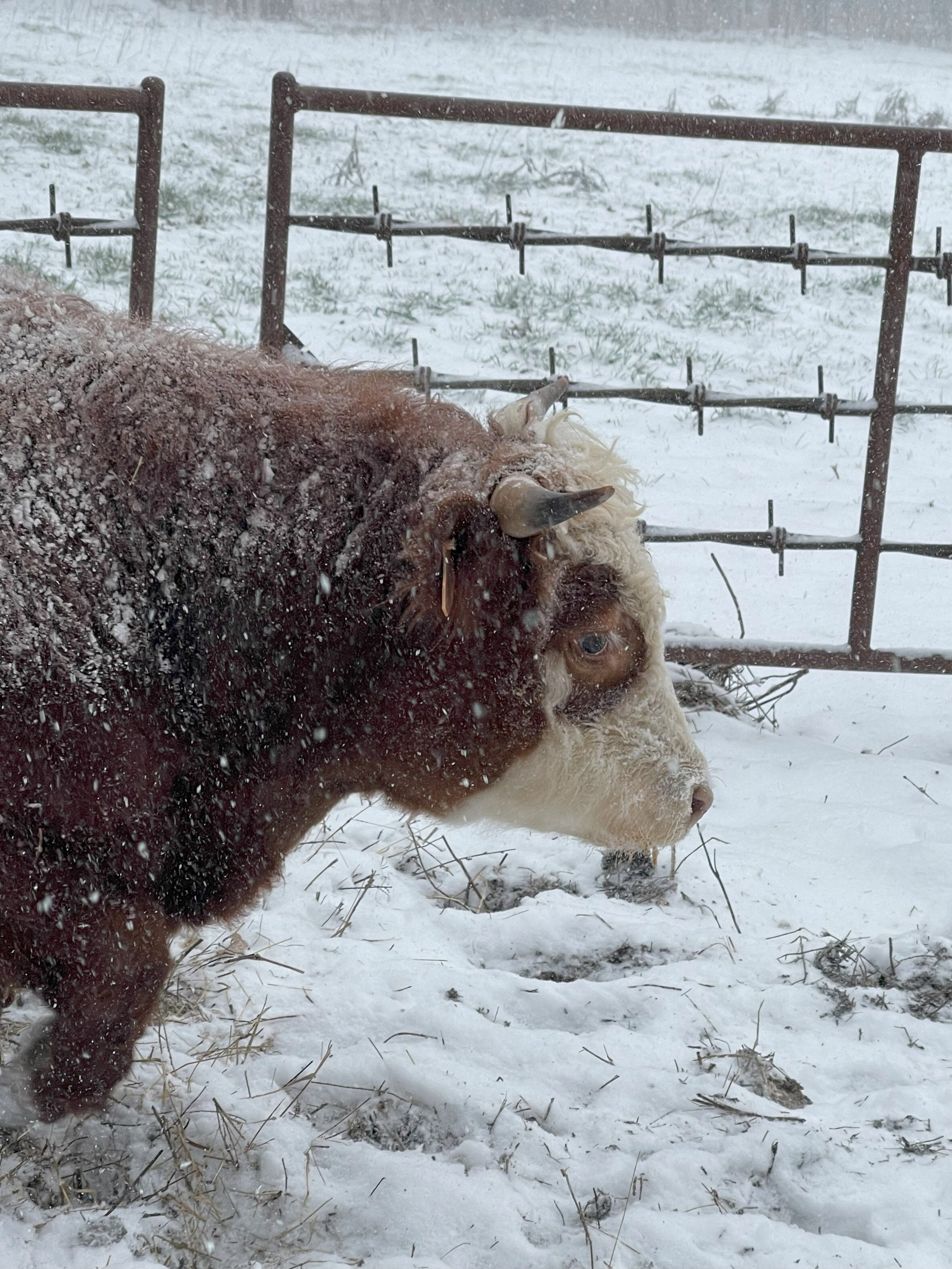


South Dakota
We have big barbwire partners in South Dakota. Here is more about the great state of South Dakota. There are more than 28,000 farms in South Dakota and the population is 924,669 and is known as the coyote state. The state bird is the Ring-necked Pheasant and the flower is the American Pasque. SD joined the United States simultaneously with North Dakota in 1889 to be the 39th and 40th state. The capital is Pierre and the largest city is Sioux Falls. South Dakota borders North Dakota, Minnesota, Iowa, Nebraska, Wyoming, and Montana. South Dakota generated around $14.7 billion in agricultural cash receipts with the highest valued commodities being corn, cattle and calves, and soybeans. “South Dakota’s cattle population outnumbers the state’s human residents by roughly a 4-to-1 margin, the highest ratio in the country. As of January 2023, the state had 3.6 million head of cattle -- 4% of the nation's inventory. With a human population of roughly 920,000, that puts the cattle-to-people ratio at 3.9. Nebraska is second, followed by North Dakota and Wyoming.”

Have questions?
*
Have questions? *
Florida
We have big barbwire partners in FL - here is a little bit about the great state of Florida. Florida has a population of 23,462,518 and is nicknamed the Sunshine state. The state of FL is 65,758 square miles and is bordered by Georgia and Alabama. Florida’s state bird is the Northern Mockingbird and the flower is the orange blossom. The largest city and capital is Tallahassee. FL was the 27th state to join the union in 1845. Florida produces oranges, watermelon, grapefruit, bell peppers, corn, tomatoes, strawberries, and cabbage. The average farm size is 218 acres. “Florida’s 44,400 farms ranches utilized 9.7 million acres and continue to produce a wide variety of safe and dependable food products. From the citrus groves, other produce, and the nurseries in central and southern Florida, to the cattle and calves throughout the state, these farms and ranches provide Florida with a large and stable economic base.” ‘All cattle and calves in Florida totaled at 1.56 million head, unchanged from last year. This is the smallest inventory in Florida since 1951 and has declined by 120,000 head since the cyclical peak in 2019. Beef cattle numbers in Florida increased by 0.3 percent (~3,000 head) since 2024 totaling 865,000 head.” “There are more than 886 thousand head of cattle and 15,000 beef producers throughout Florida. Currently, Florida ranks 13th in overall cattle numbers nationwide. The three top ranking counties for cattle are Okeechobee, Highlands, and Osceola counties. Cash receipts from cattle and calf sales totaled over $546 Million.”
How is Duffer’s Big Barbwire made?
New, hot rolled steel is used in our custom built machine to manufacture our big barbwire.
Kansas
We have big barbwire partners in KS – here is a little bit about the great state of Kansas. KS is nicknamed the Wheat state and the state flower is the wild native sunflower. The KS state bird is the Western Meadowlark. Kansas joined the union in 1861 and was the 34th state to join. “Kansas has a land area of 81,758.6 square miles and a water area of 519.6 square miles. It is the 13th largest state by area. Kansas is bordered by Nebraska, Colorado, Oklahoma, and Missouri.” Kansas’ agricultural crops are cattle, wheat, corn, soybeans, sorghum, hay, milk, and cotton. There are 54,800 farms in Kansas occupying 44,600,000 acres of land across KS. Wichita is the most populated city in KS and the capital is Topeka. Other highly populated cities include Overland Park, Kansas City, and Topeka. Here are a few agricultural facts about cattle in Kansas:
“Kansas ranked third nationally with 5.85 million cattle on ranches and in feed yards as of January 1, 2026. That's a little over twice the state's human population of more than 2.9 million.
Kansas ranks first in the value of beef and beef products exported at $1.67 billion in 2023
Cattle and calves represented 61% of the 2024 Kansas agricultural cash receipts.
Cattle generated $14.8 billion in cash receipts during 2024.
Kansas ranks second nationwide in commercial cattle processed with 5.9 million head in 2025.
Kansas ranked second in fed cattle marketed with 5.4 million in 2023. That represents 22% of all cattle fed in the United States.”